1957 Ford Thunderbird Base
Price: $39,997
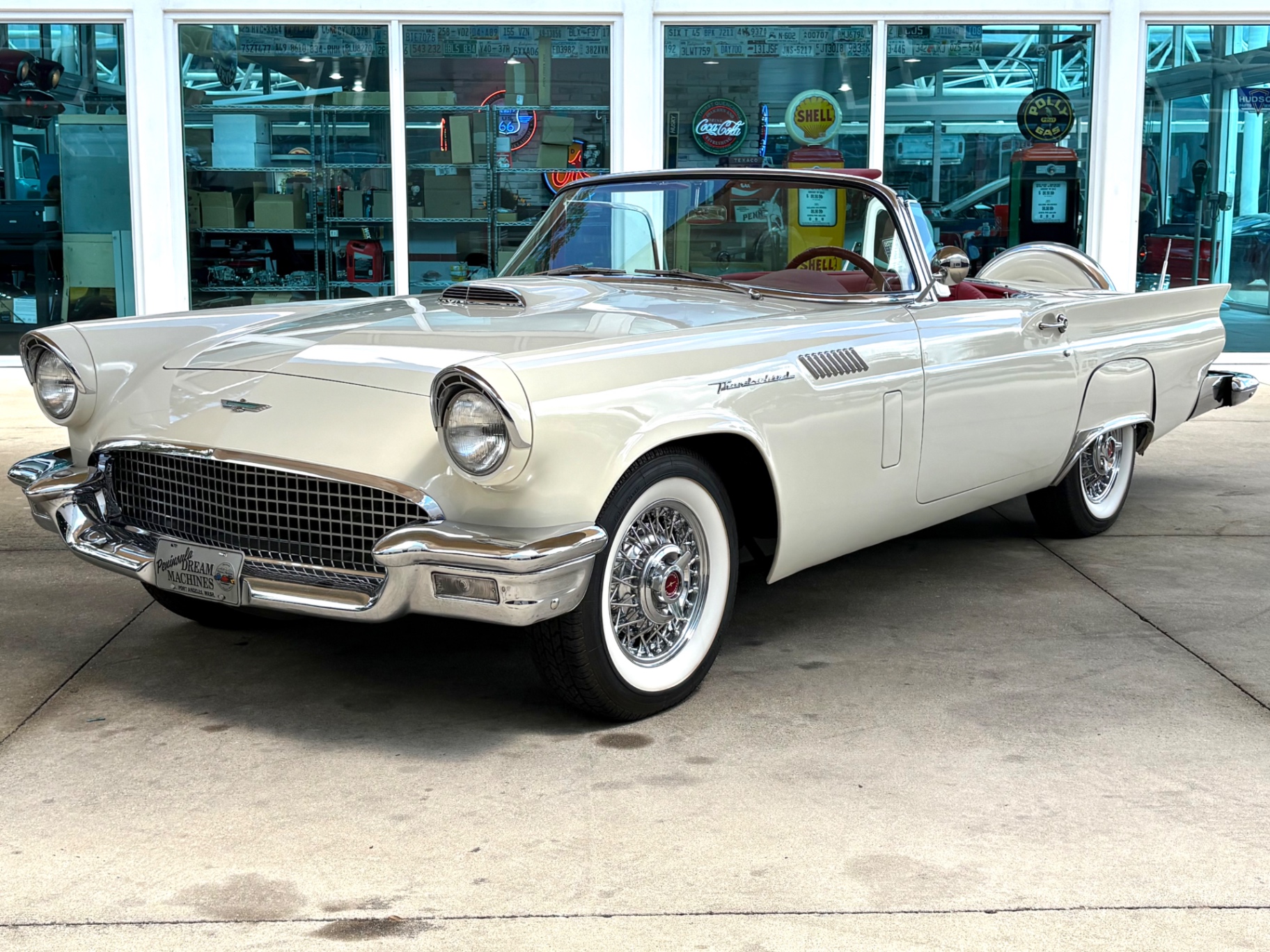
The 1957 Ford Thunderbird holds a specific place in American automotive history that no other car can claim. It was the last year of the two-seat Thunderbird before Ford went to the four-seat "Squarebird" body in 1958, a decision driven by sales data and executive pressure. Ford sold 21,380 units in 1957, making it the highest-production year of the three-year original run. Because of that transition, collectors have always placed a premium on 1955, 1956, and 1957 Thunderbirds — and within that group, the 1957 is the most refined version of the original design. It received a longer front end with a larger hood, restyled front fenders with louvers, revised tail fins, and the new porthole hardtop that addressed one of the biggest complaints buyers had about the earlier removable hardtop's blind spots. This particular 1957 Ford Thunderbird started its life in California and spent most of it in family hands — which goes a long way toward explaining why the body and paint present as solidly as they do. California cars from this era avoided decades of salt, moisture, and freeze-thaw cycles that accelerated rust on vehicles that lived their lives in the Midwest and Northeast. The underside photos on this car confirm what a dry-climate history looks like: clean framing, no visible rot in the frame rails, and intact structure throughout. That kind of foundation is not easy to find on a nearly 70-year-old open-body car. The color combination — Colonial White over a full red leather interior — was one of the more requested combinations of the era and photographs exactly as you would expect. The contrast between the white body and the deep red cabin is sharp and period-correct. The 1957 Thunderbird was available with two versions of the 312 cubic inch Y-block V8. The standard version produced 245 horsepower, while the four-barrel equipped version — which is what this car carries — was rated at 270 horsepower from the factory. Ford also offered a supercharged 312 that year, but those were far less common and came with a significant reliability trade-off. The naturally aspirated four-barrel 312 is widely considered the sweet spot of the three options: strong output, simpler mechanically, and a proven combination for street use. The finned Thunderbird valve covers are a detail that matters to knowledgeable buyers. They are a visual signature of the 1957 T-Bird engine bay, die-cast aluminum with the Thunderbird script, and they are period-correct to this car. Replacements are available in the reproduction market, but original finned covers in good condition add to the car's overall presentation. Power runs through a Ford-O-Matic three-speed automatic, which was the right gearbox choice for this engine in 1957. It shifts smoothly at highway speeds and keeps the driving experience relaxed, which is appropriate for what the Thunderbird was designed to be — a personal luxury car that happened to perform well, not a track weapon. Power steering and power brakes are both present, which makes this car entirely manageable to drive in modern conditions. The dual exhaust system exits through the bumper in the correct 1957 fashion, with the outlets integrated into the rear bumper tips — a detail that sets the 1957 apart from the 1955 and 1956 models visually from the rear. The underside photos show a solid, dry chassis with no evidence of the kind of damage that sidelines cars and inflates restoration budgets. The interior of this 1957 Ford Thunderbird is finished in red leather throughout — seats, door panels, dashboard top, and carpet. The Thunderbird's cockpit was a deliberate design exercise in driver orientation. The instrument cluster wraps toward the driver and houses a full set of gauges, including the tachometer and clock that are present on this car. The diamond-pattern aluminum trim on the dash face and door panels was a 1957 update that gave the interior a more finished look compared to earlier years. The telescopic steering wheel is one of the better practical features on this car. Ford introduced it to address the tight quarters of the Thunderbird's two-seat cockpit, and it allows the driver to set a comfortable driving position before swinging it forward to make entry and exit easier. The red leather wrap on the wheel is correct to the interior color and shows well in person. Power windows and a power seat are both on board, which were genuine luxury items in 1957. The Town and Country AM radio sits in the correct position in the center of the dash and is the right unit for the car. Having the original-style radio in place matters for show judging and for the overall feel of the interior. The soft top is included alongside the porthole hardtop, which means this car can be driven open or closed depending on conditions. The porthole window in the hardtop — added for 1957 — resolved a significant visibility complaint from 1956 Thunderbird owners who found the blind quarter panels on the earlier hardtop dangerous in traffic. The body on this 1957 Ford Thunderbird is described as strong, and the photographs support that. Colonial White is an unforgiving color for body defects — waves, repairs, and thin spots show up clearly in direct sunlight — and this car presents without the common concerns on the flanks and doors. The 1957 Thunderbird received a styling update that lengthened the front end by roughly a foot compared to the 1955 model, which provided room for the larger Y-block engine and gave the car a more proportional stance. The front fender louvers on this car are correct to the 1957 model year and add a functional-looking detail to the front quarters. The hood scoop is another 1957-specific addition that works with the overall shape of the revised nose. The continental spare tire mount on the rear deck is one of the most recognizable design details on a 1957 Thunderbird. It was a factory option that Ford had offered since the mid-1950s on various models, and on the T-Bird it reinforces the personal luxury character of the car. Chrome wire wheels with whitewall tires complete the exterior in exactly the combination that buyers specified when these cars were new. The chrome on the bumpers and trim pieces, including the rear bumper exhaust outlets, presents well in the photos. The porthole hardtop is with the car, as is the soft top — giving the next owner the flexibility to run either configuration. Both tops being present and accounted for is worth noting because the soft top, in particular, is a component that often goes missing or deteriorates on cars that have been stored for extended periods. A 1957 Ford Thunderbird with a California history, the correct 312 four-barrel V8, a full power option list, and a well-documented color combination does not come along without some patience. The two-seat Thunderbird had a three-year run and a total production across all three years of roughly 53,000 cars. Of those, the ones that present with solid structure, correct details, and a complete dual-top setup represent a narrower segment of what the market actually offers at any given time. This car checks those boxes without requiring the next owner to start a list of deferred issues before the car leaves the driveway. For more information on this 1957 Ford Thunderbird, call Skyway Classics in Sarasota, Florida at 941-254-6608.
- Mileage: 93,165 mi
- Transmission: 3-Speed Automatic
- Body Type: Convertible
- VIN: D7FH134551
- Stock #: MIU121423
- Location: Sarasota, FL