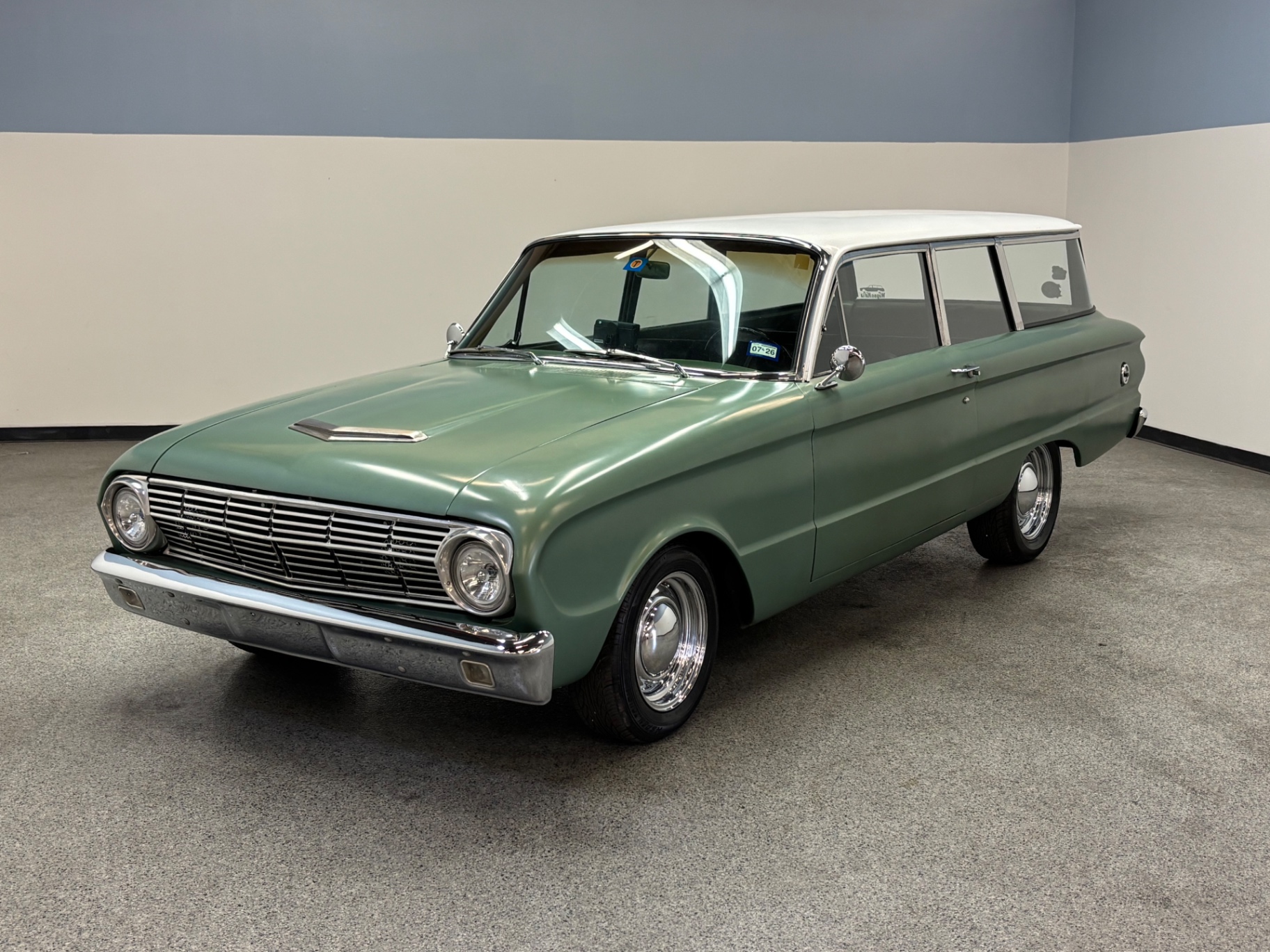
1963 Ford Falcon Wagon
Price: $29,997
The 1963 Ford Falcon is not a car most people associate with performance, and that is exactly what makes one like this so interesting. Ford sold the Falcon as an economy car starting in 1960, and it became one of the best-selling compact cars in America during the early 1960s. By 1963, the lineup had expanded to include sedans, convertibles, hardtops, and wagons — but the 2-door wagon was never a high-volume body style. Only 7,322 two-door Falcon wagons were built for the 1963 model year, and with six decades of attrition behind us, the number of solid survivors is genuinely small. The VIN on this car decodes to confirm it was built in San Jose, California, assembled as a 1963 model, and leaves no ambiguity about the body style — this is the two-door wagon, the short-roof variant that gives the Falcon a profile completely different from its four-door counterpart. It carries the compact dimensions and unibody construction Ford engineered for the platform, which is worth understanding: the 1963 Falcon shares its basic architecture with what eventually became the original 1964-and-a-half Mustang. Ford engineers used the Falcon's floorpan, front suspension geometry, and rear axle as the starting point when they developed the Mustang in a hurry. That is not trivia — it is the reason V8 swaps and performance upgrades translate so cleanly to these cars. The hard engineering work was already done. This particular 1963 Ford Falcon has been built as a street-driven restomod. It is not a show trailer queen and it is not a rough project. It occupies the middle ground that experienced car guys tend to prefer: a car that is already done, already sorted, and ready to drive. The 302 cubic inch small block under the hood, the Hurst floor shifter, the Flowmaster dual exhaust, the lowered stance — these are the choices of someone who understood what the Falcon's light weight and tight dimensions could become with the right power behind them. The engine in this 1963 Ford Falcon is a 302 cubic inch V8, Ford's small block that shares its basic family lineage with the 289 and 351 Windsor family. On a car that originally came equipped with an inline six or at most a small displacement V8, the 302 is a meaningful upgrade in power density without adding excessive weight to the nose. The 302 is also one of the more well-supported engines in the hobby — parts are plentiful, knowledge is widespread, and the combination of a Weiand intake manifold and Holley 4-barrel carburetor on top means this engine breathes well above stock specification. The Weiand is a proven street intake choice that prioritizes mid-range torque over top-end peak numbers, which suits a car like this perfectly. The cold air intake system on this build takes inspiration from the Thunderbolt drag program Ford ran in 1964, using large-diameter ducting with dual cone filters to pull cooler outside air directly into the carburetor rather than pulling from the heat-soaked engine bay. The visual effect under the hood is dramatic — the color-matched green ducting fills the engine compartment from side to side — but the function is sound. Cooler, denser air at the carburetor improves combustion efficiency and adds measurable throttle response. The dual exhaust exits through Flowmaster mufflers, which produce the characteristic chambered tone that has been a fixture on American V8 builds since the 1990s. The undercarriage photos confirm the floor is solid. The body-on-frame appearance of the unibody floor is clean and well-sealed, with no visible rot or patchwork. The chrome alternator on the driver's side of the engine bay is a presentable detail that keeps the engine bay consistent in its theme. The 3-speed automatic transmission connects through a Hurst floor ratchet shifter — a combination that gives the driver direct control over shift points without the mechanical complexity of a manual swap. Braking is drum all around, which is the stock configuration for this generation Falcon. This is worth noting for buyers who plan to use the car on public roads regularly. The suspension has been set with a lowered and raked stance, giving the car a purposeful stance that works with the two-door wagon roofline rather than fighting it. The interior of this 1963 Ford Falcon wagon has been kept largely in the spirit of the era while adding instrumentation that makes it more usable as a driver. The dash has been painted in the same satin green as the exterior and detailed with custom pinstriping — a hand-drawn botanical motif that runs across the dash face and gives the interior a finished, intentional look rather than the appearance of a half-completed project. The stock Falcon steering wheel is retained, which is the correct call on a build like this. The original wheel has the right diameter and spoke design for the period, and replacing it with an aftermarket unit would undercut the overall presentation. The Dolphin aftermarket gauge cluster replaces the original instrument pod with individual round gauges — typically including oil pressure, water temperature, volts, and fuel — giving the driver actual information the factory dash never provided. Seating front and rear is bench configuration, covered in black vinyl with cloth inserts that show the typical wear pattern of a car that has been used and enjoyed. The front bench is in better shape than a lot of wagons this age, and the rear fold-down seat adds the utility that makes the two-door wagon body style worth having over a sedan. When that rear seat drops, you have a useful cargo area inside a car that is 181 inches long overall — more than enough room for a set of golf bags, a weekend's worth of gear, or whatever the occasion calls for. The door panels match the black vinyl theme, carpeting and floor mats are present, and the heater and defroster are functional. The glass is in good shape with no visible crazing or distortion. The exterior of this 1963 Ford Falcon wagon wears a satin green metallic finish with a white roof — a two-tone combination that works with the Falcon's clean, uncluttered body lines. The satin sheen on the green keeps the car from looking over-restored, which fits the overall character of the build. The white roof provides contrast at the roofline without demanding a full two-tone stripe treatment on the lower body. It is a restrained approach that reads well at any distance. The front and rear chrome bumpers are in presentable condition, holding up the era-correct look of the car's face and tail. Chrome side mirrors on both doors are period-appropriate in their form, upgraded in their functionality. The headlights have been upgraded from the original sealed-beam units, improving forward visibility at night without altering the outward appearance of the grille surround. The custom hood scoop is not a factory Falcon piece — it was not an option in 1963 — but it sits proportionally on the hood and ties into the Thunderbolt-style cold air intake system underneath. The chrome wheels with black sidewall tires give the car a clean, purposeful stance that suits the lowered ride height. The Falcon's beltline and greenhouse are simple and straight, which means paint and trim issues are easy to assess. Glass and body trim are reported good, and the photos confirm the body panels are straight without the evidence of major collision repairs or filler-heavy work. The 1963 Ford Falcon 2-door wagon occupies a specific and narrow category of early 1960s American iron. The body style is rare — 7,322 built, with a shrinking number of viable survivors. The platform has real engineering significance as the direct precursor to the original Mustang. And this particular example has been built with a clear point of view: a 302 V8 with a proper intake and carburetor, dual Flowmasters, a Hurst shifter, lowered stance, and a coordinated green-on-green theme that runs from the exterior through the engine bay. It drives, it's sorted, and it's ready to be used. If you want to have a conversation about this 1963 Ford Falcon, contact Skyway Classics in Sarasota, Florida at 941-254-6608.
- Mileage: 10,957 mi
- Transmission: 3-Speed Automatic
- Body Type: Wagon
- VIN: 3H29U160146
- Stock #: MIU76459
- Location: Dallas, TX