1971 Chevrolet Corvette LT1
Price: $74,997
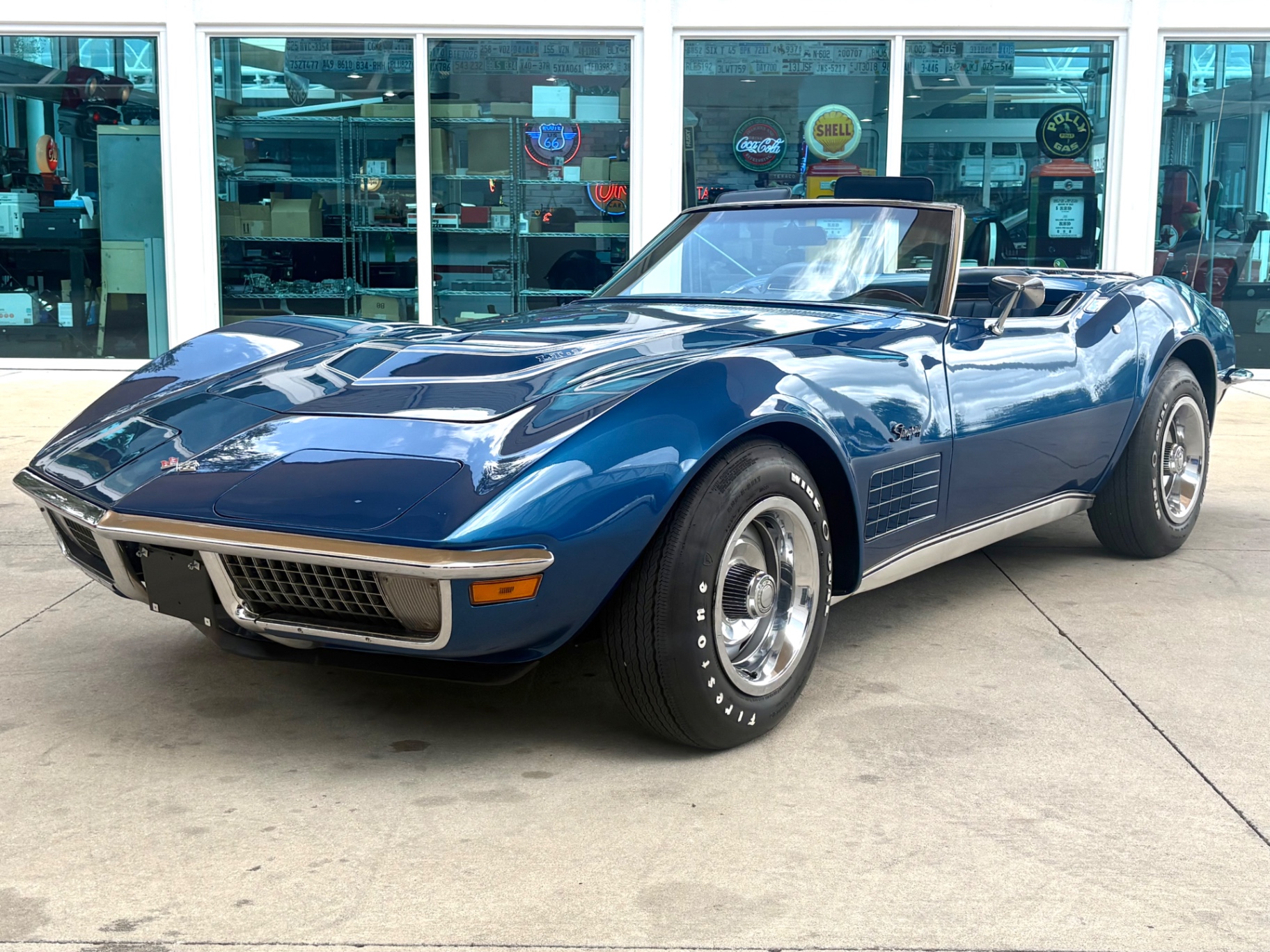
The 1971 Chevrolet Corvette Stingray is one of the most important years in C3 history, and not for reasons that are always obvious at first glance. By 1971, General Motors had mandated that all its engines be capable of running on regular low-lead fuel, and compression ratios were dropping across the board. The base 350 fell to 270 horsepower. The big-block 454 saw similar cuts. But the LT-1 — the solid-lifter, high-revving 350 developed largely by Zora Arkus-Duntov — held the line. In 1971, the LT-1 was rated at 330 horsepower, making it the highest-output small-block Corvette engine available that year and the last truly high-compression LT-1 before emissions and fuel quality requirements significantly softened the formula in 1972. That context matters because it tells you exactly what this car is. This 1971 Chevrolet Corvette Stingray LT-1 convertible is a numbers-matching example of arguably the best driver's Corvette of its era. The LT-1 was never the biggest engine in the Corvette lineup, but it was the one the factory engineers built for people who actually wanted to drive. Its solid-lifter cam, high-compression heads, and free-breathing induction gave it a character that the big-blocks couldn't match through corners. Paired here with the M21 close-ratio 4-speed manual — the gearbox specifically paired with the LT-1 to make the most of its power band — this is the drivetrain combination that Corvette enthusiasts have sought out for decades. The VIN decodes to confirm this car was built as a convertible at the St. Louis assembly plant in 1971, with the LT-1 engine and the S-suffix indicating it is a genuine open-body car, not a T-top coupe. Everything about this car's specification points to a buyer who ordered it to drive, not just to park. Mulsanne Blue over a matching blue vinyl interior is a factory-correct, period-appropriate combination that suits the lines of the C3 body exceptionally well. Fewer than 5,300 LT-1 Corvettes were produced for 1971 across both coupe and convertible body styles combined. The convertible was already becoming a smaller part of the mix as buyers shifted toward the T-top, making a genuine LT-1 convertible a relatively scarce configuration within an already low-production engine option. The heart of this 1971 Corvette Stingray is the numbers-matching LT-1 350 cubic inch V8 rated at 330 horsepower. To understand why this engine matters, you have to understand what it was designed to do. The LT-1 used a solid-lifter camshaft, an 11.0:1 compression ratio in 1971, large-port cylinder heads, and a single four-barrel carburetor on an aluminum intake manifold. It was not a torque engine in the traditional sense — it rewarded drivers who were willing to work the gearbox and keep the engine in its power band. That is precisely why it was paired from the factory with the M21 close-ratio Muncie 4-speed, a gearbox with tighter spacing between ratios than the wide-ratio M20. The combination suited road course driving as well as spirited highway use. The M21 close-ratio 4-speed shifts with the mechanical precision you expect from a Muncie unit. The pairing of the LT-1 engine and the M21 transmission was not a coincidence — Chevrolet specifically calibrated the available gear options to match engine characteristics, and the M21 was the correct choice for extracting the most from the LT-1's narrower effective power band compared to a torquey big-block. Backing the transmission is a Positraction limited-slip differential, which puts power to both rear wheels under acceleration rather than breaking traction at one corner. The rear suspension is the independent multi-link setup that Corvette carried through the entire C3 generation — a configuration that, when combined with four-wheel disc brakes, gave the 1971 Corvette Stingray stopping and cornering capability well ahead of most American production cars of the period. The four-wheel disc system was already standard equipment on the Corvette by this point, and it remains one of the most practical reasons to prefer a C3 over earlier Corvette generations for actual driving use. The undercarriage photographs confirm what a clean car this is. The frame, floorpan, and suspension components show no rust perforation, no patchwork, and no signs of deferred neglect. This is a Florida-area car that has clearly been maintained and stored properly. The interior of this 1971 Chevrolet Corvette Stingray is finished in blue vinyl throughout, matching the exterior color and presenting as a well-preserved, honest original environment. The bucket seats retain their shape and show no significant cracking or distortion in the vinyl. The door panels are intact with their chrome trim strips and the original lock and window hardware in place. The gauge cluster is the full C3 arrangement, with the large speedometer and tachometer occupying the twin-pod binnacle directly ahead of the driver — a layout that gives the driver clear sight lines to both engine speed and road speed at a glance. The auxiliary gauges are mounted in the center console tunnel cluster, covering fuel level, water temperature, oil pressure, battery voltage, and clock. This is a complete, functional set of information that tells the driver what the engine is doing in real time. The tachometer redlines at 7,000 rpm, appropriate for the LT-1's solid-lifter valvetrain. The wood-rim steering wheel is correct for the period and presents well, with the polished alloy spokes and Corvette crossed-flags horn button intact. The center console houses the M21 shifter with its period ball-top shift knob, and the console itself retains the warning light panel and storage area. The FM radio is fitted in the dash center panel below the auxiliary gauges, a period-correct Delco unit. The carpets and floor mats carry the Corvette crossed-flags emblem at the foot wells. Overall, the interior presents as a preserved rather than restored environment — the difference being that nothing here looks artificially freshened. The 1971 Chevrolet Corvette Stingray wears Mulsanne Blue, a factory color that suits the C3 body's long hood and flowing fender lines particularly well. It is a deeper, richer blue than the lighter alternatives offered in the period palette, and it reads differently in sunlight versus shade — more vibrant in direct light, more restrained in shade. The body panels are fiberglass, as they were throughout the C3 generation, and they show good panel alignment with no evidence of significant repair or repaint across the major surfaces. The LT-1 hood stripe graphics are present and correctly placed, running longitudinally across the center of the domed hood in a contrasting finish. These stripes were specific to LT-1-equipped cars and serve as an exterior identifier of the engine underneath. The Stingray fender badges are in place on both front fenders, and the rear deck carries the Corvette script lettering. The original Rally wheels are fitted with Firestone Wide Oval tires, the correct period tire brand and style for a 1971 Corvette. Firestone supplied Wide Oval tires as original equipment on Corvettes during this era, and seeing the Firestone name on the sidewalls is one of those details that matters to judges and knowledgeable buyers alike. The chrome luggage rack is fitted to the rear deck, a period accessory that was popular on convertible Corvettes and adds a functional and visually appropriate touch without altering the car's originality. The car comes with two tops — a blue hard top, and a white unit included with the car. Three roof options in one transaction gives the next owner maximum flexibility for year-round use. Outside rearview mirrors are fitted to both doors. The dual exhaust exits through the iconic square-tip outlets at the rear fascia, flanking the license plate recess in the way that has defined the Corvette's tail end since the late 1960s. A numbers-matching 1971 Chevrolet Corvette Stingray LT-1 convertible with the M21 close-ratio 4-speed is a specific and deliberately assembled combination. This was not the cheapest way to buy a Corvette in 1971 — the LT-1 carried a significant option premium, the M21 was an additional cost, and the convertible body was priced above the coupe. A buyer who ordered this car new knew exactly what they were getting and paid for it. The fact that the matching engine remains in the car fifty-plus years later, in a clean and well-preserved example, is what separates this Corvette from the majority of C3s on the market. If you are looking for a 1971 Corvette Stingray LT-1 that you can drive, show, and hold with confidence in its documentation and integrity, this car deserves a serious look. To schedule a viewing or ask questions, call Skyway Classics in Sarasota, Florida at 941-254-6608. We are happy to walk you through the car in detail and arrange inspections.
- Mileage: 51,245 mi
- Transmission: M-21 Closed Ratio 4 Speed
- Body Type: Convertible
- VIN: 194671S102810
- Stock #: MIU76480
- Location: Sarasota, FL