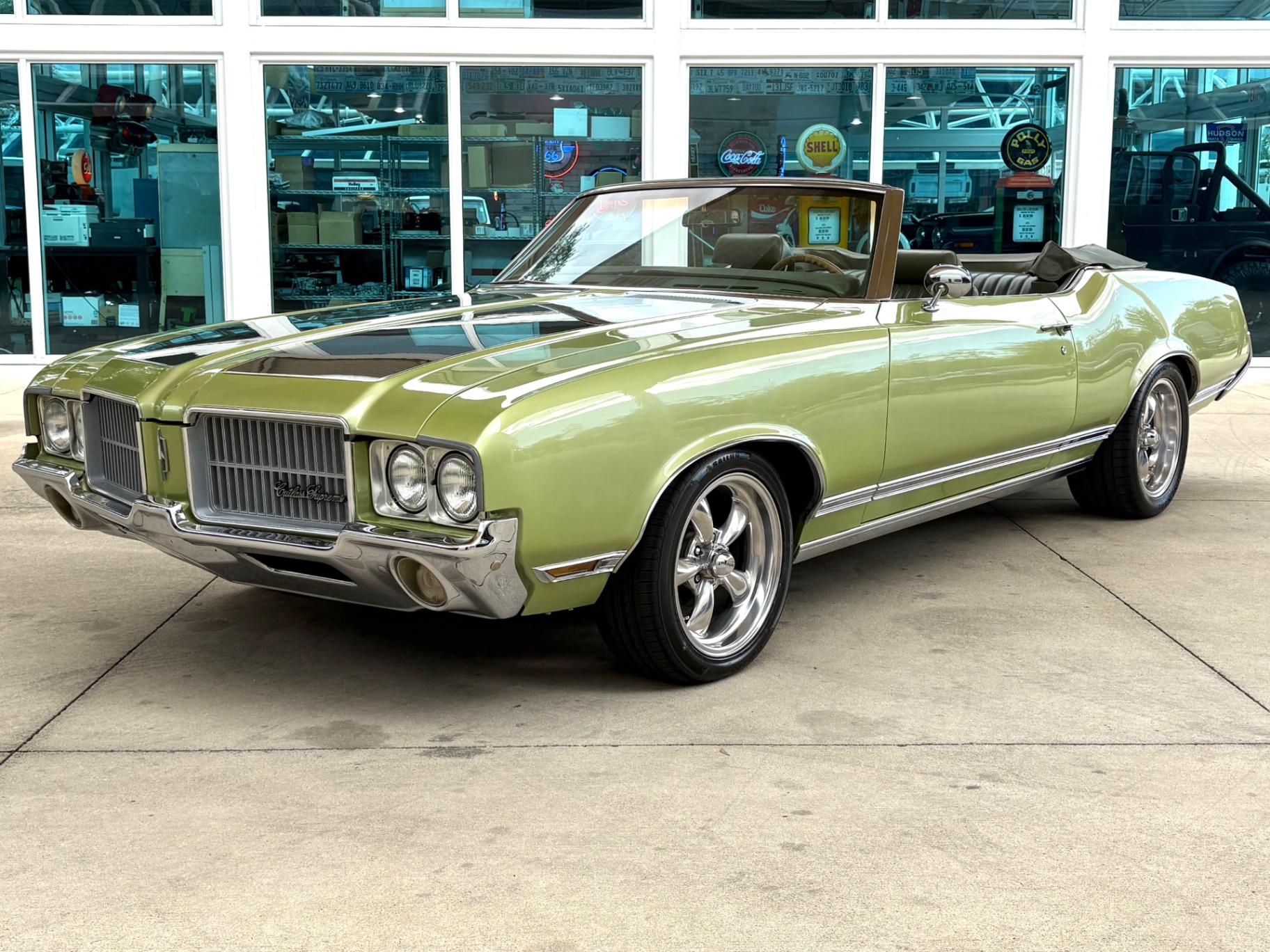
1971 Oldsmobile Cutlass Supreme Convertible
Price: $59,997
The 1971 Oldsmobile Cutlass Supreme convertible sits at an interesting crossroads in American automotive history. By 1971, the muscle car era was winding down under pressure from rising insurance rates, tightening emissions regulations, and a shift in buyer priorities. Oldsmobile responded not by abandoning performance, but by repositioning the Cutlass Supreme as a car that combined a comfortable, well-equipped interior with a genuine V8 drivetrain — a formula that made the Cutlass the best-selling car in America for much of the 1970s. The convertible body style makes this example considerably rarer than the coupe. By 1971, open-top cars were already fading from the American market. Concerns about rollover safety standards threatened to end convertible production altogether, and General Motors would eventually discontinue most of its convertible offerings after 1975. A 1971 Cutlass Supreme convertible with this level of factory equipment is not a car you encounter often. The VIN on this car decodes to confirm it was built at the Lansing, Michigan assembly plant — Oldsmobile's home facility — in the 1971 model year, as a Cutlass Supreme convertible with the Rocket 350 V8 engine. Lansing-built cars are generally well-regarded among Oldsmobile collectors for assembly quality. The color combination on this car is worth noting. The Lime Green exterior, matching green convertible top, and all-green vinyl interior create a period-correct monochromatic presentation that is exactly what buyers were ordering in 1971. Earth tones and bold greens were popular factory choices that year, and a car wearing its original color scheme with a coordinating top has a visual coherence that repainted or recolored cars rarely achieve. The Rocket 350 V8 was Oldsmobile's own engine — not a Chevrolet small-block, not a shared GM unit in any meaningful sense at this point in its development. Oldsmobile engineering had a long tradition of building its own powerplants, and the 350 carried that forward. In 1971, the Rocket 350 was rated at 240 horsepower in four-barrel form, though that figure was measured using the new SAE net rating standard that GM adopted for 1972 — making direct comparisons to earlier gross-rated figures somewhat misleading. What matters is that the engine is a torque-rich, low-revving V8 well-suited to the weight and character of the Cutlass Supreme. The four-barrel carburetor ensures it breathes properly at highway speeds and responds cleanly when you ask for acceleration. The 3-speed Turbo-Hydramatic automatic transmission shifts through a floor-mounted console shifter — a setup that was a factory option on the Cutlass Supreme and gives the car a much more driver-oriented feel than a column-shifted automatic would. The combination of floor shifter, console, and bucket seats makes this feel like a proper personal luxury car rather than an appliance. Braking is handled by power front disc brakes, which was an important upgrade over the standard four-wheel drum setup. On a car of this weight, front discs make a meaningful difference in stopping distances and fade resistance, particularly in Florida driving conditions where frequent stops are part of the routine. The suspension has been upgraded with Bilstein shock absorbers on all four corners. Bilstein's gas-pressure monotube design provides more consistent damping than the original shocks and is a well-regarded upgrade that improves handling and ride quality without altering the car's character. The undercarriage has been treated with black undercoating, which is visible throughout the underside photos and indicates the car received attention there during its life. The undercarriage presents cleanly, with no visible structural concerns. Exhaust exits through a dual Flowmaster system. The Flowmaster mufflers are clearly visible in the undercarriage photos and provide a noticeable improvement in exhaust tone and flow compared to stock. The exhaust tips exit behind the rear bumper on each side, which is correct for the body style. The interior of this 1971 Cutlass Supreme convertible is a full-green environment — green vinyl bucket seats, green door panels, green carpet, and green dash padding. The woodgrain trim on the instrument panel, door panels, and lower dash fascia provides the visual contrast Oldsmobile intended, and it remains intact and presentable throughout. The "Cutlass Supreme" script badge on the passenger-side lower dash is in good condition and confirms the trim level. The wood-rim sport steering wheel is a factory option that connects directly to the Oldsmobile badge on the center horn button. It wraps a three-spoke chrome hub and gives the driver's position a finished, purposeful look. The gauges are housed in a wood-grained instrument cluster and include a speedometer reading to 120 mph, a combination oil pressure and temperature gauge, and a clock — all correct for this model. The FM Stereo radio is the factory unit, set into the dash in the correct position. The fader control on the right side of the radio allows the driver to balance sound between front and rear speakers — a feature that was considered upscale in 1971 and is still functional here. The air conditioning controls are positioned below the radio and to the right, with the original slider controls intact. The bucket seats are covered in green vinyl with vertical pleating across the seat backs and cushions, which is correct for the Cutlass Supreme of this era. Headrests are included and remain in position. The rear seat carries the same vertical-pleated green vinyl and shows the original seatbelts still in place. The center console houses the floor shifter with its wood ball knob and provides storage between the front buckets. Overall, the interior is a correct, cohesive example of how this car was delivered from the factory. The Lime Green paint is one of the more assertive color choices available in 1971, and on the Cutlass Supreme convertible body it reads exactly as it was intended — not as a novelty, but as a confident factory color that suits the lines of the A-body. The 1971 Cutlass Supreme received a mild restyle that gave it a more formal roofline on the hardtop models and cleaner body sides on the convertible. The hood accent stripes — darker in tone than the body — run the length of the hood and were a popular option that referenced the performance-oriented thinking of the era without crossing into full muscle car territory. Chrome side body moldings run along the lower body, and both the front and rear bumpers present well. The rear bumper in particular is notable — the 1971 Cutlass used a full-width rear bumper that incorporated the taillights in a way that was distinctive to that generation. In the undercarriage photos, the rear bumper is clearly visible and shows good chrome condition. The green convertible top matches the exterior and interior color theme and is operated by the power top switch located on the lower dash near the steering column. The top mechanism is functional. When lowered, the Cutlass Supreme convertible has a long, flat decklid profile that was characteristic of the A-body convertibles of this period. The retro 5-spoke wheels are a modern-style aftermarket fitment that is in keeping with the resto-mod presentation of the car. Continental tires are visible in the undercarriage photos. The wheel and tire combination fills the wheel wells appropriately without altering the ride height or suspension geometry. The 1971 Oldsmobile Cutlass Supreme convertible occupies a specific and increasingly recognized place in the collector market. It is not a high-strung muscle car, and it was never meant to be. It is a well-equipped, open-air personal luxury car built by a division that took pride in its own engineering, finished in a factory color combination that holds together visually from every angle, and backed by a V8 engine that has proven itself reliable and easy to maintain over more than fifty years. The convertible body style, factory air conditioning, power top, bucket seats, console, and wood-rim steering wheel represent exactly the kind of option list that made the Cutlass Supreme the car it was. The undercarriage work and suspension upgrades indicate that someone invested real money in this car's long-term usability, not just its appearance. If you have questions about this 1971 Oldsmobile Cutlass Supreme convertible, call Skyway Classics in Sarasota, Florida at 941-254-6608. We are happy to walk you through the car in detail, arrange an inspection, or discuss shipping options.
- Mileage: 2,269 mi
- Transmission: 3-Speed Automatic
- Body Type: Convertible
- VIN: 342671M232043
- Stock #: MIU76445
- Location: Sarasota, FL