1971 Oldsmobile 442 W-30
Price: $72,997
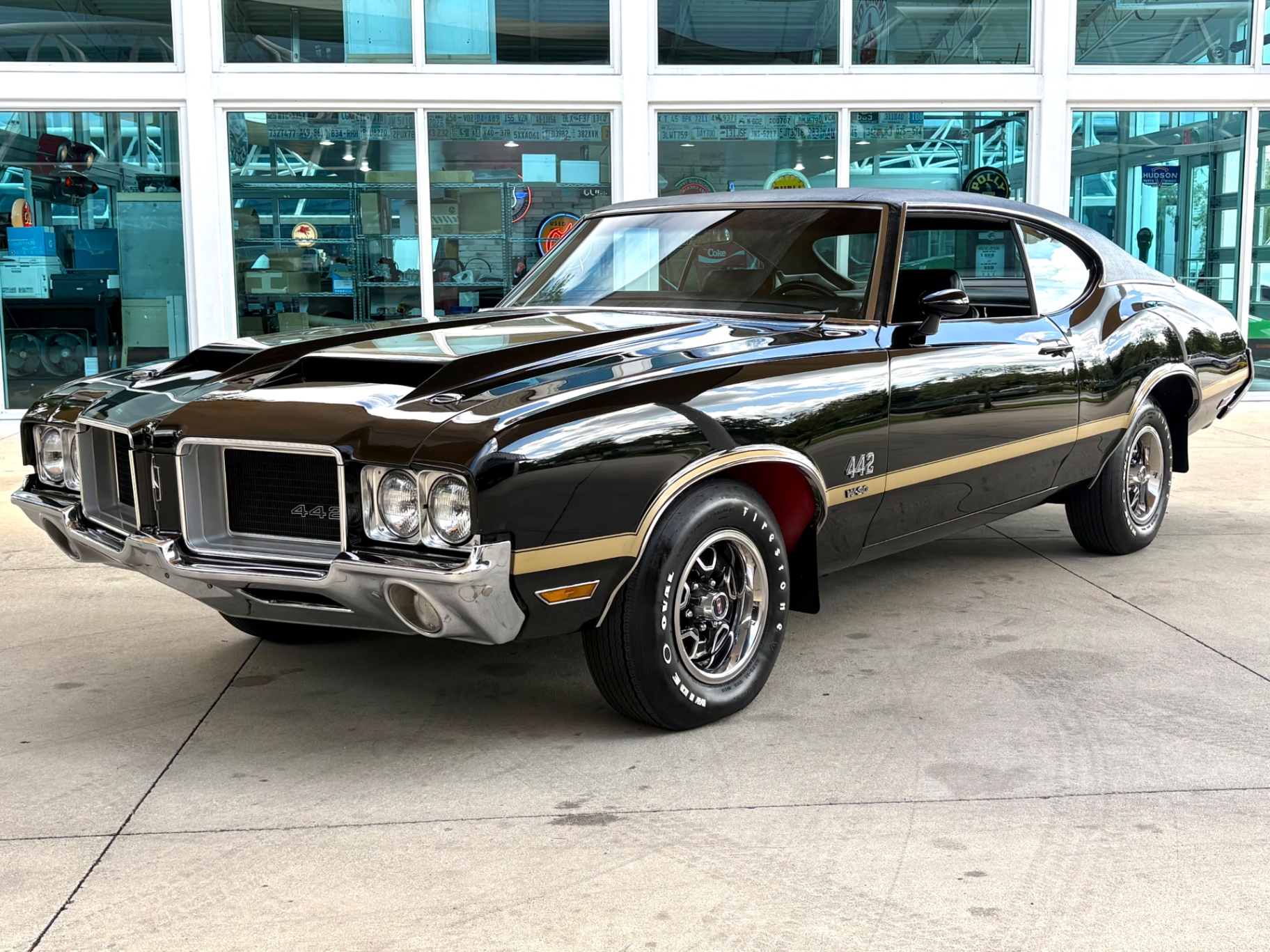
The 1971 Oldsmobile Cutlass 442 W-30 sits at a specific crossroads in American muscle car history that no other car occupies. This was the last year the 4-4-2 existed as its own standalone model. Starting in 1972, Oldsmobile demoted the 4-4-2 to an appearance package on the Cutlass Supreme — a trim level, not a separate model. That decision makes every legitimate 1971 Oldsmobile Cutlass 442 a documented endpoint, and makes a W-30 car from that year something considerably rarer. To understand what the W-30 package meant, you have to go back to how Oldsmobile built it. The W-30 was not simply a cold-air induction add-on. It was a factory performance package centered on a blueprinted 455 cubic inch V8 with a special high-lift camshaft, an aluminum intake manifold, ram-air induction through an open-element air cleaner, and a low-restriction dual exhaust system. Oldsmobile rated the W-30 455 at 350 gross horsepower with approximately 460 lb-ft of torque. Those figures understate what the engine actually produced on the dyno — a common factory practice in the early 1970s as insurance companies began using horsepower ratings to set premiums. The torque number is the honest figure. This engine pulled hard from low rpm, which is exactly what made big-block Oldsmobiles so effective on the street. The production numbers confirm how rare this car is. Oldsmobile built 7,589 total 4-4-2s for 1971. Of those, only 920 were equipped with the W-30 package. That is roughly 12 percent of an already limited production run, in the final year the model existed as a standalone nameplate. Numbers like that are why serious collectors pay attention to 1971 Oldsmobile Cutlass 442 W-30 cars. The Body by Fisher door jamb tag present on this car confirms the 1971 model year, the body style code 34487 identifying it as a 2-door hardtop coupe, and the TR 930 interior trim code for the black vinyl bucket seat interior. The April 1971 build date is also confirmed. This car was originally built as a blue car and has since been refinished in black. The engine in the car is a period-correct 455 and carries all the correct W-30 presentation details — it may not be the numbers-matching original, but it is accurately presented and period correct for what a W-30 car looked like when it left Lansing. The engine bay presents the way a correct W-30 car should. The block and valve covers are painted red, which is the factory-correct finish for the W-30 455. The open-element air cleaner carries an Oldsmobile-branded lid with gold lettering and a gold filter element — correct in both form and color. The chrome valve cover accents and the Moroso breather are period-appropriate additions that do not detract from the W-30 appearance. The GM emission control decal is present and legible, which adds to the authenticity of the engine bay presentation. The wiring harness follows a correct factory-style routing with no visible improvised work, and the battery is fresh. Be clear-eyed about one thing: the 455 in this car is period correct but may not be the original numbers-matching engine. We are representing it honestly as a correctly presented W-30 455 from the same era. Buyers focused strictly on numbers-matching provenance should factor that into their evaluation. Buyers who want a genuine W-30 442 that runs, drives, and presents correctly will find this car delivers exactly that. The TH400 3-speed automatic is backed by a floor-mounted console shifter. The TH400 was the standard transmission behind the W-30 in 1971 — Oldsmobile made the 4-speed manual available, but most W-30 cars left the factory with the TH400, which handled the torque of the 455 without complaint. Power brakes and power steering are both confirmed with the booster and pump visible in the engine bay. Underneath, the car has been freshly coated on the floorpans and frame rails. There is no visible rust, rot, frame damage, or repair welds. The driveshaft is clean with no corrosion. The rear axle housing shows no leaks, and the coil spring rear suspension is intact and unmodified. A rear sway bar is present — a feature that contributed to the 442's reputation for handling better than most domestic muscle cars of the era. Replacement rear shocks have been installed. The GR70-14 radial tires on the rear are the correct size for this application. The TR 930 trim code confirmed on the door jamb tag identifies this as the black vinyl bucket seat interior, and the interior matches that exactly. The front buckets are in excellent condition with headrests on both sides. The rear bench seat also carries headrests and presents in equally good shape. Original seat belts are present front and rear. The dashboard is the correct 442-specific unit with the woodgrain trim panel running across its face. The 442 badge appears on the passenger side of the dash, which is a detail specific to this model. The gauge cluster is complete and includes the speedometer, tachometer, fuel gauge, temperature gauge, and oil gauge. The tachometer is particularly satisfying in a car with this much low-end torque — it tells you exactly what the engine is doing without requiring any guesswork. On the center console sits the Oldsmobile manifold vacuum gauge — a period-correct accessory that reads intake manifold vacuum in inches of mercury and gives a real-time indication of whether the engine is cruising or working hard. The face reads Economy on the high-vacuum side and Power on the low-vacuum side, with the Oldsmobile name printed at the bottom of the dial. It is a functional piece of instrumentation that also looks exactly right in this car. The AM/FM radio is a Blaupunkt unit — a West German brand that was considered premium audio equipment in the early 1970s and was offered as a factory option on higher-end GM cars. It fits the dash opening correctly and suits the overall character of the car. The floor-mounted TH400 shifter sits in a woodgrain console that carries the Oldsmobile Rocket emblem on the console plate. Black carpet with period-correct rubber floor mats covers the floor. Power windows are present and functional. Chrome door handles and trim are in excellent shape. The day/night rearview mirror is present. The rear window defrost vent is visible in the rear package shelf area. The car wears black paint over a body that was originally blue from the factory. The current black finish suits the car well, particularly against the gold accent stripes that run along the lower body sides — a combination that reads correctly for a 1971 442 and aligns with period factory color and stripe offerings. The black vinyl top is in good condition. The 442 and W-30 badges appear in their correct positions on the exterior. The front end is the distinctive 1971 Cutlass 442 nose, with its four round headlights flanking a blacked-out grille with the Oldsmobile Rocket emblem centered in it. The 1971 front end design is unique to this model year — the 442 grille was revised from 1970 and would not carry forward, since the model would be discontinued after this production run. The chrome rear bumper is in excellent condition. Twin exhaust tips exit cleanly below the bumper on both sides — the correct exit point for a W-30 car. The rear taillights are set into the bumper in the distinctive 1971 arrangement. The underside view from the rear shows the freshly coated floorpans, the clean driveshaft, the solid rear axle, and the dual mufflers positioned symmetrically — everything in the right place and in solid condition. The 1971 Oldsmobile Cutlass 442 W-30 is a documented endpoint in American muscle car history. Only 920 were built with the W-30 package, in the final year the 4-4-2 existed as its own model. This example has a confirmed April 1971 build date, the correct TR 930 black vinyl bucket seat interior, all the correct W-30 engine bay presentation details, a solid and freshly coated undercarriage, and a complete, functional interior with a full gauge cluster, power windows, a Blaupunkt radio, and the Oldsmobile manifold vacuum gauge on the console. The engine is a period-correct W-30 455 that may not be the original unit — we are representing that honestly — but it presents correctly and is equipped as a W-30 car should be. For a buyer who understands what 1971 means to the 442 nameplate and what the W-30 package represented at the end of the muscle car era, this car makes a straightforward case for itself. To schedule a viewing or ask specific questions, call Skyway Classics in Sarasota, Florida at 941-254-6608.
- Mileage: 58,235 mi
- Transmission: TH400 3-Speed Automatic
- Body Type: Coupe
- VIN: 344871M181101
- Stock #: MIU28544
- Location: Sarasota, FL